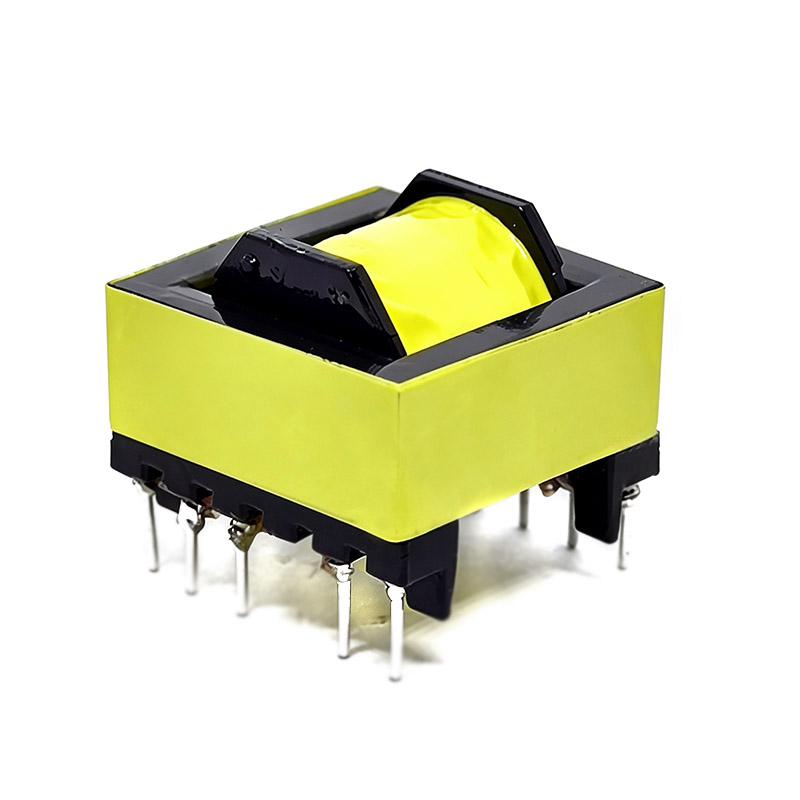
In magnetic component selection, "high-frequency transformers" and "power transformers" are often mentioned together. Although both operate on the principle of electromagnetic induction, they differ fundamentally in operating frequency, core material, structural design, and application scenarios. Choosing the wrong type can result in poor efficiency and excessive temperature rise at best, or core saturation and device burnout at worst. This article systematically compares the two types of transformers from principles to selection, helping engineers make the right decision quickly in power, audio, and industrial applications.
1. Same Principle, Different Operating Frequencies
Both types of transformers follow Faraday's law of electromagnetic induction: an alternating current in the primary winding generates an alternating magnetic flux, which is coupled through the core to the secondary winding, inducing a voltage. The voltage ratio equals the turns ratio—a fundamental rule that holds for both line-frequency and high-frequency operation.
The real dividing line lies in the operating frequency. Power transformers typically operate at the utility line frequency of 50/60Hz, while high-frequency transformers operate at switching frequencies ranging from tens of kHz to several MHz. According to the electromagnetic induction formula, the higher the frequency, the greater the power that can be transferred per unit core cross-section. This is why high-frequency transformers can achieve higher power density in a smaller size—the physical basis for the continuous miniaturization of switching power supplies.
2. Core Materials: Silicon Steel vs. Ferrite
The difference in operating frequency directly dictates the choice of core material. Line-frequency power transformers typically use silicon steel laminations (grain-oriented or non-oriented), which offer high permeability, high saturation flux density, and low cost at low frequencies. However, eddy current losses in silicon steel rise sharply at high frequencies, making it unsuitable for applications above tens of kHz.
High-frequency transformers, on the other hand, commonly use ferrite cores (such as PC40 or PC95 materials). Ferrite offers high electrical resistivity and low high-frequency eddy current losses, making it the preferred choice for switching power supplies. In applications demanding even higher efficiency and smaller size, nanocrystalline, permalloy, or ultra-microcrystalline cores may also be used. Shenzhen Zhi Xiang Yuan Electronics Co., Ltd. has been深耕 in the magnetic component industry for over two decades and can match the appropriate core material to different topologies based on operating frequency and efficiency targets.
| Comparison Dimension | Power Transformer | High-Frequency Transformer |
|---|---|---|
| Operating Frequency | 50/60Hz line frequency | 20kHz–several MHz |
| Typical Core | Silicon steel (EI/toroidal) | Ferrite (EE/EI/PQ/EC), nanocrystalline |
| Power Density | Lower, larger size | High, small size with high power |
| Typical Efficiency | 85%–92% | 90%–96% |
| Loss Sources | Copper loss dominant, low core loss | Core loss and skin/proximity effects significant |
| Typical Applications | Linear power supplies, audio equipment, instrumentation, isolation | Switching power supplies, adapters, DC-DC converters, PV inverters |
3. Application Scenarios: Different Priorities
Power transformers are commonly found in applications sensitive to ripple and noise or requiring simple linear regulation, such as professional audio equipment, laboratory instruments, vintage amplifiers, and traditional isolation power supplies. Their advantages lie in simple circuitry, low electromagnetic interference, and strong overload capability.
High-frequency transformers are the core of modern switching power supplies, widely used in phone chargers, LED drivers, laptop adapters, server power supplies, PV inverters, and automotive DC-DC converters. Thanks to the miniaturization and high efficiency enabled by high frequencies, they have become the mainstream choice in consumer electronics and the new energy sector.
- Prioritizing small size, high efficiency, and wide input voltage range: Opt for high-frequency transformers with switching power supply topologies.
- Prioritizing low noise, simplicity, reliability, and strong overload capability: Opt for line-frequency power transformers with linear regulation.
- Audio coupling and impedance matching: Use dedicated audio transformers, whose frequency response and distortion specifications differ from standard power transformers.
4. Selection Guide: Five Parameters You Must Confirm
Regardless of which type of transformer you choose, the following five parameters are essential inputs for selection and customization—none can be omitted:
- Operating frequency and topology: Determines the core material and whether it's flyback, forward, or full-bridge/half-bridge.
- Input/output voltage and power: Determines turns ratio, wire gauge, and core size.
- Inductance and turns ratio: Affects energy storage, coupling, and loop stability.
- Safety and insulation requirements: Primary-to-secondary isolation voltage, creepage distance, and whether potting or shielding is needed.
- Temperature rise and cooling conditions: Determines the loss budget and whether forced air cooling is required.
In high-frequency applications, special attention must be paid to skin effect and proximity effect. Multi-strand Litz wire or sandwich winding techniques are often used to reduce AC copper loss. If you're unsure about the conversion of these parameters, you can provide the power supply specification sheet to the engineering team at Zhi Xiang Yuan Electronics, and we can assist with the preliminary core and winding design.
FAQ
Q1: Can a high-frequency transformer directly replace a line-frequency power transformer?
No, they cannot be simply interchanged. The core materials, turns, and operating frequencies are completely different. Connecting a high-frequency transformer to 50Hz mains will cause rapid saturation and overheating due to excessive flux density. Conversely, using a line-frequency transformer in a high-frequency circuit results in huge losses and extremely low efficiency. You must reselect based on the actual operating frequency.
Q2: How can I tell if a transformer core is entering saturation?
Typical signs include spikes in the primary current waveform, abnormal temperature rise of components, reduced load capacity of the power supply, or even switching transistor failure. You can check whether the current waveform appears "flat-topped" on an oscilloscope, or calculate whether the maximum flux density Bmax approaches the saturation flux density of the core material.
Q3: What information is needed to customize a high-frequency transformer?
We recommend providing: input/output voltage and power, operating frequency and topology, inductance and turns ratio for each output, safety insulation class, size and mounting constraints. A schematic or reference sample is even better. The more complete the information, the shorter the prototyping and mass production cycle.
Recommended Reading